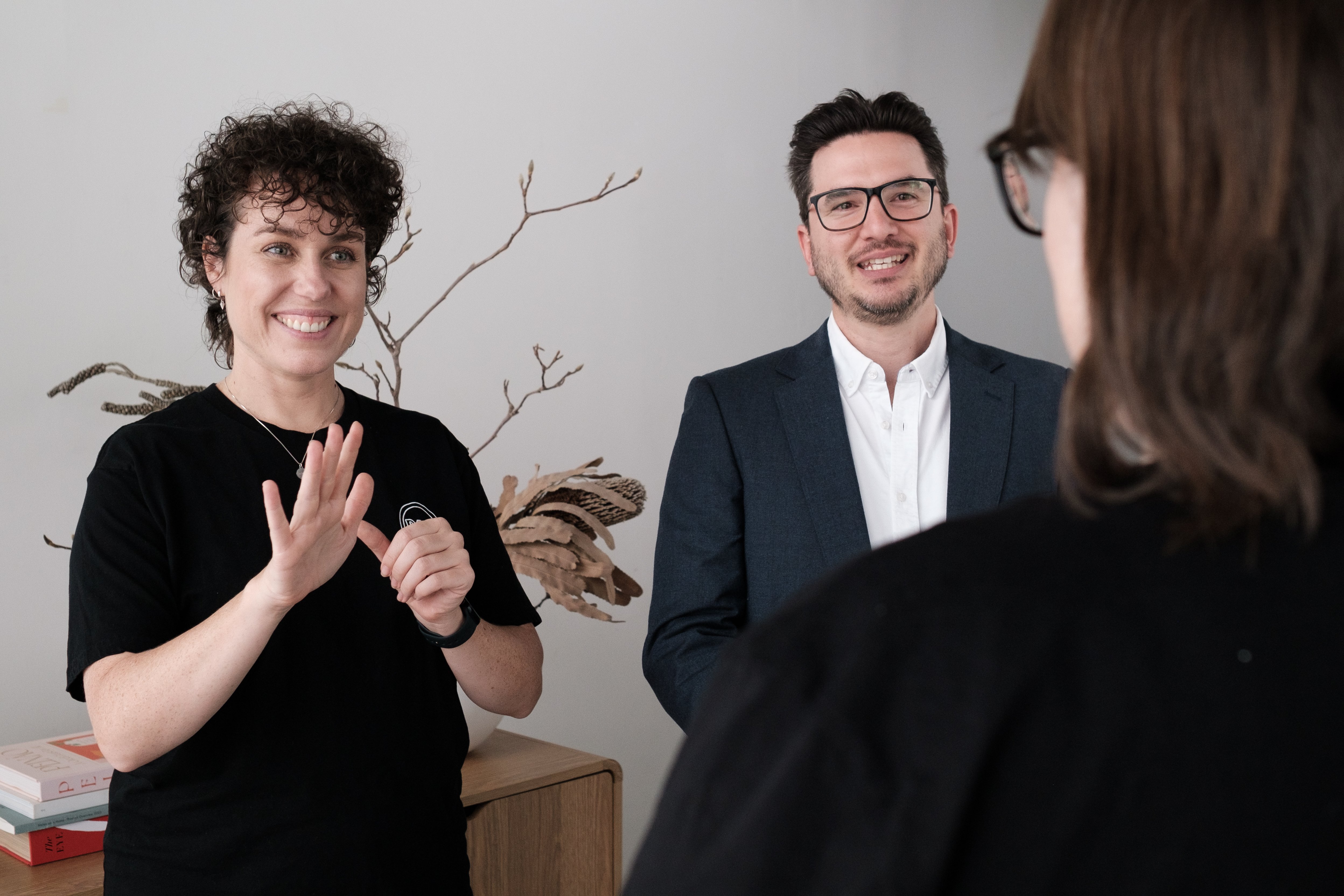
Using Every Tool in Your Kit Doesn't Make You a Lazy Interpreter
Be honest. How many times have you reached for your phone mid-appointment, found the perfect image to explain something, and then felt a little flicker of guilt - like you'd somehow cheated?
I want to talk you out of that feeling for good.
There's a word for the thing you just did. The first time you hear it, it sounds like something that belongs solely in a research paper.
The word is translanguaging.
The concept began in 1980s Wales, where the educator Cen Williams coined the term "trawsieithu" to describe students moving fluidly between Welsh and English inside a single lesson ➡️ receiving information in one language and applying it in another.
García and Li (2014) took it further. They described it as a dynamic process: multilingual people drawing on every resource available to them — language, gesture, image, whatever is at hand — to think, to communicate, and to make meaning together.
Li Wei also describes a translanguaging instinct — the innate human drive to reach for every available resource to make meaning. We don't naturally narrow our communication when things get hard. We widen it. We grab the gesture, the fingerspelled form, the body shift, the scrap of paper.
So why do so many of us feel guilty about it? Somewhere in our training, many of us absorbed the belief that a "real" interpreter does it all in Auslan and English, seamlessly and invisibly, and anything else is cheating. We chase the illusion of smoothness. We'd rather pass something on "cleanly" than pause and risk looking like we don't know.
But ask yourself honestly: who is that smoothness serving? If a Deaf client leaves an appointment having watched a flawless performance they didn't understand, we have failed at the only thing that matters.
Translanguaging does not make you a lazy interpreter. It makes you a better one.
So what does this look like in practice? Here are a few ideas you can put to work.
1️⃣ Point to what's already available. Sometimes the strongest move is to direct attention away from yourself. Let the Deaf person watch the demo, read the slide, see the professional pour the coffee or do the first-aid hold. Don't be the hero fumbling it in Auslan when the real thing is right there.
2️⃣ Use physical models. The mouth model at the dentist, the skeleton at physio, the knee diagram on the specialist's wall. If it's in the room, use it.
3️⃣ Google it. A quick image on your phone can do wonders. Or, even better, ask the people you're working with: "Do you have a picture of that we could show?"
4️⃣ Draw it, embody it, use props. A rough sketch of a car crash. Role-playing the moment so a child can actually see it. Lego for a timeline, colour for emotion, string for distance, toys for people. Ask for an animated explainer, or film the physio's demonstration so your client can rewatch it at home.
None of this is a deviation from professional practice. It is professional practice, done with intention.
Final musings
It's unlikely you'll use every one of these, every single day. But I hope you'll stop apologising for reaching into the bag when you need to.
Next time a concept gets tricky, ask one question: will this Deaf person go home actually understanding? If the answer points you toward a diagram, a drawing, a point, or a pause - do it.
You're not here to be smooth. You're not here for anyone's entertainment. You're here to do whatever it takes to get the meaning across. After all, isn't that our job?